
 Posts
Posts


10 years ago
Showing posts with label Mathematics. Show all posts
Showing posts with label Mathematics. Show all posts
Thursday, February 13, 2014
Mathematical beauty activates same brain region as great art or music
Mathematical beauty activates same brain region as great art or music: People who appreciate the beauty of mathematics activate the same part of their brain when they look at aesthetically pleasing formula as others do when appreciating art or music, suggesting that there is a neurobiological basis to beauty.
Saturday, June 18, 2011
Fibonacci Trading | Learn to Unlock the Power of Fibonacci Numbers | EWI
Fibonacci Trading | Learn to Unlock the Power of Fibonacci Numbers | EWI
Are you a Fibonacci trader? Did you read The Da Vinci Code? Does math, history, science or technology really get you going?
If you answered "yes" to at least one of these questions, then you've come to right place. (If you answered "yes" to all of them, then congratulations: you are the most easily excitable person on the planet.) Just kidding; we're even more excited than you.
Are you a Fibonacci trader? Did you read The Da Vinci Code? Does math, history, science or technology really get you going?
If you answered "yes" to at least one of these questions, then you've come to right place. (If you answered "yes" to all of them, then congratulations: you are the most easily excitable person on the planet.) Just kidding; we're even more excited than you.
Happy Phi Day -- Perfect Day for Some Phinancial Fun | Elliott Wave International
Happy Phi Day -- Perfect Day for Some Phinancial Fun | Elliott Wave International: "It’s June 18, which is also written as 6-18. So let me be the first to wish you a Happy Phi Day!
Just as some people who are fascinated by the irrational properties of the ratio known as pi (3.14...) celebrate it on Pi Day (March 14 or 3-14), here at the financial forecasting firm where I work, we are fascinated by phi (0.618...), and we want to introduce more people to its interesting properties."
Just as some people who are fascinated by the irrational properties of the ratio known as pi (3.14...) celebrate it on Pi Day (March 14 or 3-14), here at the financial forecasting firm where I work, we are fascinated by phi (0.618...), and we want to introduce more people to its interesting properties."
Sunday, May 15, 2011
Dreaming the pyramid
Dreaming the pyramid
"I dance to music unheard,
feeling the formless,
sensing the hidden,
yielding to the innocent,
protecting the undefeated,
and worshipping the uncrowned.
Things are more real to me in my light realm,
than riches and status are to you in yours.
I am Spirit!"There are two ways to think of the number twenty-two: the first is as a number, one finding its rightful place in between the numbers twenty-one and twenty-three. The other way to think of it is as a symbol.
Twenty-two occupies a special place in all forms of contemporary numerology and is often referred to as the Master Number or Master Builder. Metaphysicists the world over are also well aware of the 22nd card of the Tarot and its special significance in the Major Arcana. Commonly referred to as "the Fool", this character seems to care little about material wealth or prestige (or for that matter, any of the other things mortals deem vital to be able to rise up in the world). To the untrained eye, all the Fool cares about is his dreamworld.
"I dance to music unheard,
feeling the formless,
sensing the hidden,
yielding to the innocent,
protecting the undefeated,
and worshipping the uncrowned.
Things are more real to me in my light realm,
than riches and status are to you in yours.
I am Spirit!"There are two ways to think of the number twenty-two: the first is as a number, one finding its rightful place in between the numbers twenty-one and twenty-three. The other way to think of it is as a symbol.
Twenty-two occupies a special place in all forms of contemporary numerology and is often referred to as the Master Number or Master Builder. Metaphysicists the world over are also well aware of the 22nd card of the Tarot and its special significance in the Major Arcana. Commonly referred to as "the Fool", this character seems to care little about material wealth or prestige (or for that matter, any of the other things mortals deem vital to be able to rise up in the world). To the untrained eye, all the Fool cares about is his dreamworld.
Saturday, May 7, 2011
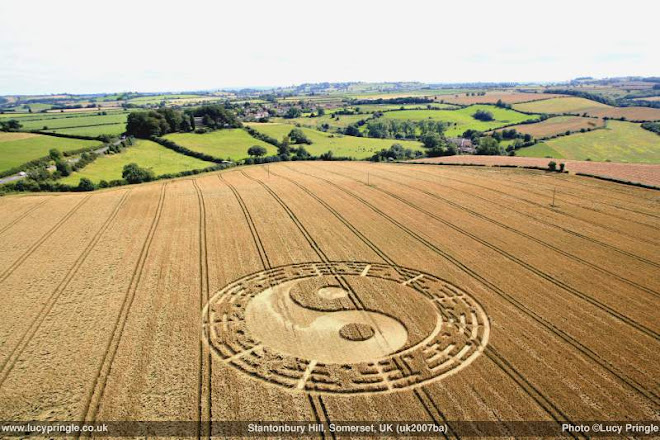
Everyday Health 每天康: Cycles: Pi, Phi, Fibonacci, and the Yi Jing
Everyday Health 每天康: Cycles: Pi, Phi, Fibonacci, and the Yi Jing: "Fascinating fascinating fascinating story in the New Yorker this week. It uses a profile of financial trader Martin Armstrong to explore the idea of cycles as they apply to historical, political and economic events (Armstrong predicted, to the day, the stock market crash of October 1987). The article does a wonderful job of exploring the many different types of cycles and their various proponents, but ends up portraying Armstrong as a bit of a nutjob"
Overview
Overview: "What is Phi?
Phi ( = 1.618033988749895... ), most often pronounced fi like 'fly,' is simply an irrational number like pi ( p = 3.14159265358979... ), but one with many unusual mathematical properties. Unlike pi, which is a transcendental number, phi is the solution to a quadratic equation."
Phi ( = 1.618033988749895... ), most often pronounced fi like 'fly,' is simply an irrational number like pi ( p = 3.14159265358979... ), but one with many unusual mathematical properties. Unlike pi, which is a transcendental number, phi is the solution to a quadratic equation."
Tuesday, March 8, 2011
Forecasting and Hedging in the Foreign Exchange Markets (Lecture Notes in Economics and Mathematical Systems)
Forecasting and Hedging in the Foreign Exchange Markets (Lecture Notes in Economics and Mathematical Systems): "The growing complexity of many real world problems is one of the biggest challenges of our time. The area of international finance is one prominent example where decision making is often fraud to mistakes, and tasks such as forecasting, trading and hedging exchange rates seem to be too difficult to expect correct or at least adequate decisions. From the high complexity of the foreign exchange market and related decision problems, the author derives the necessity to use tools from Machine Learnin"
Tuesday, October 26, 2010
Women's choices, not abilities, keep them out of math-intensive fields
Women's choices, not abilities, keep them out of math-intensive fields: "The question of why women are so underrepresented in math-intensive fields is a controversial one. In 2005, Lawrence Summers, then president of Harvard University, set off a storm of controversy when he suggested it could be due partly to innate differences in ability; others have suggested discrimination or socialization is more to blame."
Tuesday, July 6, 2010
Ron Eglash on African fractals | Video on TED.com
Ron Eglash on African fractals | Video on TED.com: "'I am a mathematician, and I would like to stand on your roof.' That is how Ron Eglash greeted many African families he met while researching the fractal patterns he’d noticed in villages across the continent.
About Ron Eglash
Ron Eglash is an ethno-mathematician: he studies the way math and cultures intersect. He has shown that many aspects of African design -- in architecture, art, even hair braiding -- are based"
About Ron Eglash
Ron Eglash is an ethno-mathematician: he studies the way math and cultures intersect. He has shown that many aspects of African design -- in architecture, art, even hair braiding -- are based"
Saturday, June 12, 2010
How Fibonacci Techniques Identify Market Turns | Elliott Wave International
How Fibonacci Techniques Identify Market Turns | Elliott Wave International: "In the 13th Century, an Italian mathematician named Leonardo Fibonacci made a remarkable discovery: Rabbits, when placed in an enclosed area for one year, will reproduce a new pair of kits in a very precise, repetitive pattern: 1, 1, 2, 3, 5, 8, and so on to 144. This chain of numbers is the Fibonacci sequence.
Since then, the relevance of the ratio (.618/1.618) has been proved time and time again, from the DNA strand to the human hand (five fingers, each with three bones) -- as the natural progression of growth and decay."
Since then, the relevance of the ratio (.618/1.618) has been proved time and time again, from the DNA strand to the human hand (five fingers, each with three bones) -- as the natural progression of growth and decay."
Subscribe to:
Posts (Atom)